
The word “transformation” has become ubiquitous in management talk, often to the point of designating programmes that are long, expensive, and disconnected from day-to-day operations. In an economic environment marked by systemic disruption, pandemics, geopolitical instability, energy shocks and technological revolutions, simple “resilience” is no longer a sufficient strategic objective.
The antifragile company: when transformation becomes a system of permanent strengthening
Let us challenge the ordinary! How do you steer a transformation that strengthens the company? Vision, strategic plans, co-construction, BI. The challenge is no longer knowing how to resist, but how to improve in the face of uncertainty. Real strategic performance is not measured by a company’s ability to execute a rigid five-year plan, but by its ability to thrive thanks to disorder. This article offers an executive steering framework for going beyond the logic of one-off “transformation programmes” and installing a system of permanent systemic strengthening. It shows how executive committee governance, the integration of agile business intelligence and the operational application of the principles of antifragility make it possible to turn shocks, mistakes and volatility into measurable competitive advantages.
I. Antifragility: from a theoretical concept to an operational necessity
Before steering, you have to define the destination. The most relevant conceptual frame for the present era is not robustness, it is antifragility.
Antifragility (Taleb): gaining from disorder
The concept, introduced by Nassim Nicholas Taleb, describes the unique property of a system that actively benefits from shocks, volatility, disorder and stressors.
For directors, the distinction in vocabulary is crucial and defines three distinct organisational states:
- The fragile: what breaks under pressure. It is an organisation optimised for a single future, which collapses when an unforeseen event (a pandemic, a disruptive competitor) occurs.
- The robust (or resilient): what withstands shocks and stays unchanged. It is the traditional objective of risk management: passive redundancies, continuity plans that allow a “return to normal”.
- The antifragile: what improves thanks to shocks. It needs disorder in order to learn, evolve and become stronger than it was before the crisis.
That distinction exposes a major flaw in modern management thinking. The obsession with pure efficiency, the hunt for waste, lean rationalisation, Six Sigma optimisation, has led companies to eliminate redundancies systematically. Yet antifragility is described as “the opposite of a rationalised, efficient system”. Those apparent inefficiencies, experimentation budgets, a diversity of suppliers, time allotted to research, structural redundancies, are in fact the source of optionality and of the capacity to adapt. In seeking maximum efficiency, many organisations have become structurally fragile.
Operational application: from business continuity to strategic steering
The application of the concept is concrete. The examples of “pandemic pivots” illustrate it: restaurants that developed profitable delivery lines, breweries that produced hand sanitiser, or textile manufacturers that turned to masks. Those companies did not merely “resist”; they used the shock to create new revenue lines and strengthen their business model.
That redefines business continuity management. A resilient approach to continuity aims to recover (a neutral outcome). An antifragile approach aims to thrive. It builds into its risk analysis the identification of the opportunities created by the disruption, and not only the mitigation of the downside.
This leads to a fundamental conclusion for governance: transformation must no longer be thought of as a “one-off programme” but as a permanent “learning loop”. A “transformation project” is, in essence, a fragile or resilient approach: the company suffers a shock, launches an expensive project to “repair” and get back to normal. “Antifragile steering” is an organisational system in which the company is in a state of continuous learning. The executive committee’s role is no longer that of a crisis project manager, but that of the architect and guardian of that systemic learning capacity.
The three operational pillars of antifragility
1. Favourable asymmetry (strategic optionality)
Rather than trying to foresee everything, the antifragile organisation multiplies small, low-cost experiments with unlimited potential gains.
It is the logic of a portfolio of options: you cap the possible losses, you maximise the opportunities.
In other words: ten small agile tests are worth more than a single large, risky bet.
2. Organisational hormesis (good stress)
An organism deprived of stress weakens. That is true for a muscle, for an immune system, and for a company.
Creating positive micro-stressors, fast feedback, short iterations, innovation sprints, makes continuous learning possible and avoids “big failures”.
The mistake becomes a mechanism of adaptation, not a sign of failure.
3. Skin in the game
An organisation is fragile when the people who decide do not live with the consequences of their choices.
Antifragility rests on accountability and decentralisation: the teams who act must be the ones who learn, adjust and own the results.
It is a culture of shared power and real responsibility.
Our method: Create, Prototype, Deploy
1. Create: positive stress
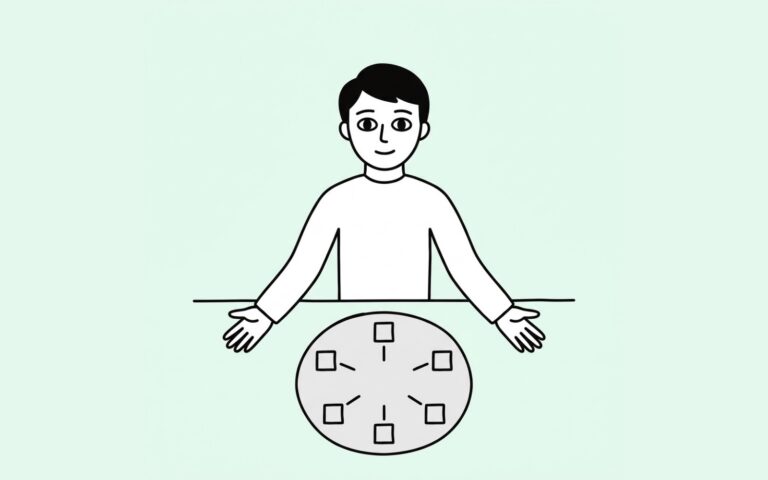
We (co)build a living strategic plan, bringing your teams and ours together in collective intelligence workshops.
That direct exchange between business, data, marketing and IT deliberately creates a constructive tension, the good stress, which brings new solutions out and breaks internal silos.
2. Prototype: favourable asymmetry
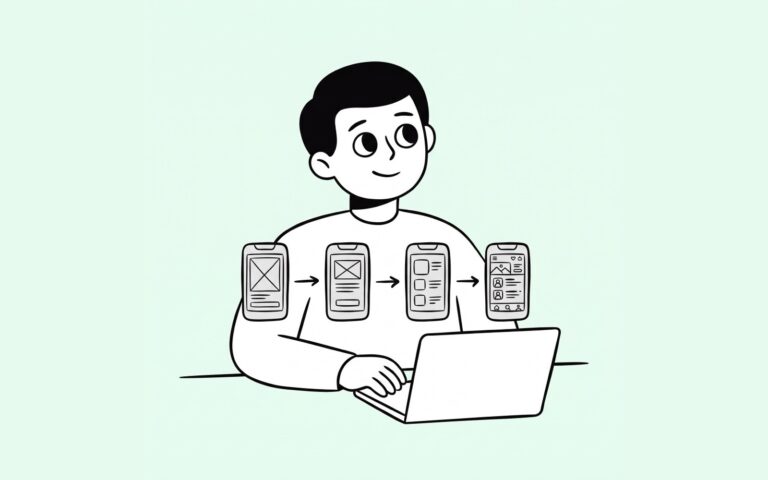
Thanks to no-code and AI, we launch minimum viable products in a few weeks, not in years.
Every prototype is a low-cost, high-potential experiment.
You learn fast, you adjust, and you never bet everything on a single project.
3. Deploy: skin in the game
We stay alongside our clients after launch.
Because an antifragile project is never finished: it learns, adapts, strengthens itself.
Our solutions evolve thanks to the data, to user feedback and to human intelligence (human in the loop).
Our success is directly tied to yours.
The co-construction approach itself, step by step, is set out in Building a strategic plan together.
II. What the executive committee has to steer today: the antifragile company
Within this new frame, the responsibility of the governing bodies is not to define technical solutions, but to steer the system that allows solutions to emerge and be tested.
The three fundamental responsibilities of the director
Steering antifragility rests on three clear executive responsibilities:
- Governing the ambition: defining the direction. The executive committee has to articulate where the transformation must create value (new revenue, reduced risk, cost optimisation, meeting sustainability objectives).
- Allocating the capacity: providing the means. That includes budgets and access to talent, but above all the technology platforms (BI in particular) that make it possible to measure impact in real time.
- Institutionalising experimentation: creating the engine. This means giving the cultural and budgetary authorisation to run fast tests, and imposing a discipline of decision based on clear metrics (stop, iterate, or scale up).
That third point is the most critical and the most difficult culturally. It is the direct application of Taleb’s barbell strategy. The company invests most of its resources (say 80 to 90 per cent) in safe, predictable activities (the core business) while allocating a small part (say 10 to 20 per cent) to speculative experiments, low in cost but with very high potential upside.
So the executive committee’s role is to protect that experimentation budget (responsibility 2) and to normalise the failure of those experiments (responsibility 3). The failure of a prototype costing fifty thousand euros is not a management failure; it is an expected outcome, an informational asset that generates valuable learning and avoids a fifty-million-euro strategic failure.
The “living” strategic plan: the map of antifragility
To steer that portfolio of bets, the executive committee’s central tool can no longer be a static PDF document. Traditional five-year strategic planning is a fragile exercise: it presupposes a predictable future. Antifragile steering calls for a “living” strategic plan.
That operational document is the map that allows governing bodies and managers to prioritise, measure and arbitrate. To be useful, it must contain five elements:
- Orientation by issue: three to five clear strategic priorities (digitalising the offering, the energy transition of production, and so on).
- Vision and horizons: a three to five year vision (the direction) broken down into measurable milestones at 12, 24 and 36 months.
- A backlog of experiments: a portfolio of prototypes and experiments attached to each priority, including sponsors, channels and dedicated indicators. This is the implementation of the barbell strategy.
- Required capabilities: identification of the internal skills, the external partners and the technology stack (BI, no-code, APIs) needed.
- “Living” status: a mandatory quarterly review and permanent adjustment. The plan is not locked.
The value of that plan lies not in the accuracy of its forecasts, but in its capacity to make adaptation easier. The executive committee no longer steers a rigid plan, it steers a portfolio of strategic options.
Proof through performance: resilience as a mandate
This approach is no longer a simple philosophical preference; it has become an imperative of performance.
Studies and analyses from the large consultancies confirm that companies actively building resilience and agility into their governance outperform their peers. McKinsey notes that “future-ready” companies, defined by their capacity to adapt (close to antifragility) and by their flexible organisational structure, are the ones creating the most economic value.
More than that, it is becoming a non-negotiable expectation. Gartner predicts that by 2025, 70 per cent of chief executives will require a culture of organisational resilience, not as a project but as an imperative of survival in the face of multiplying coincident threats: cybercrime, climate events, political instability and health risks.
Investing in this antifragile governance frame is therefore not a defensive cost. It is an offensive strategy. Gartner research shows that the best-performing companies accelerate their strategic growth investments during periods of uncertainty, while their more fragile competitors cut costs and contract. The antifragile system lets the company seize opportunities faster than the competition when shocks occur.
III. The key role of business intelligence in an agile transformation
Agile governance is impossible without an agile information system. The executive committee cannot steer by evidence if the evidence takes six months to produce. Business intelligence is the central nervous system of the antifragile company.
BI: from rear-view reporting to real-time steering
In a traditional transformation, BI is often a “technical gadget” produced at the end of the project. In an antifragile transformation, it is the critical interface between data and decision.
Its key functions include supplying real-time indicators, creating dashboards for the management committee aligned with the living strategic plan, and the ability to model “what if” scenarios in order to test hypotheses.
Integrating BI from the moment the prototypes’ indicators are defined makes the transformation “steerable and reversible”. It is the antidote to the fragility of large projects. A monolithic transformation project (waterfall-style) is irreversible: if it fails after two years and fifty million euros, the loss is total. A series of experiments steered by BI is reversible: if a dashboard shows that a prototype is not reaching its adoption objectives after three weeks, the executive committee can use that BI-decision loop to “stop” or “iterate”. The cost is minimal, the learning maximal, and the company has strengthened itself.
The necessary break: from waterfall BI to agile BI
That reversibility calls for a methodological break within IT departments. The fundamental problem is that most BI departments still operate along traditional, waterfall lines. That model is linear, sequential and rigid: defining needs, specifications, development, testing, delivery. The users, whether the business or the executive committee, only see the final product (the dashboard, the report) months or even years after the need was first expressed. By then the need has changed, the market has moved, and the tool is obsolete before it even launches.
The solution is to adopt agile BI. That approach uses adaptive planning and intense collaboration between the data teams and the end users. It aims to deliver a minimum viable product, for example a working dashboard with three critical indicators, within a few weeks (“sprints”). That MVP is tested immediately, and user feedback feeds the next sprint, creating a cycle of continuous improvement.
Agile BI in action: three examples as proof
That methodological transition is not a simple gain in IT efficiency; it is the engine of strategic performance.
- Speed and savings (insurance): a case study of an insurance company shows that adopting agile project management practices (Scrum) made it possible to cut project cycle time by 20 per cent and generate nearly five million dollars in savings. The ability to deliver faster reduces costs and increases business alignment.
- Strategic steering (energy): Renewable Energy Systems, the largest independent renewable energy company, used Microsoft Power BI combined with an agile delivery method to unify its global financial reporting. The result was improved forecasting capability and direct support for the strategic investment decisions taken by leadership.
- Risk steering (industry): a large industrial group (Fortune 500) adopted agile BI to speed up reporting on its global supply chain. Report delivery time was cut by 60 per cent, allowing faster, near real-time identification of supply chain risks.
IV. The six concrete levers for making transformation productive (and measurable)
With the frame set (antifragile governance plus agile BI), executing a productive transformation rests on precise operational levers. Those levers form the “operating system” of the company that learns.
Lever 1: map the strategic processes The first step is a diagnosis: identifying where the points of fragility sit (dependence on a single supplier, a monolithic IT system) and where the points of leverage sit (under-used data, processes with high customer impact) in the key value streams (finance, risk, growth, operations).
Lever 2: modules and clear boundaries (technical and organisational separation) This is the structural design of antifragility. Instead of monolithic legacy systems, highly optimised but extremely fragile, the organisation has to be divided into components or modules (flows, processes, microservices) with clear boundaries. That allows part of the system to fail or be changed (iterated) without threatening the whole.
Lever 3: BI-decision loops (agile governance) This is the nervous system. It is not only about having dashboards, but about establishing the governance rituals that use them. For example, the quarterly review of the living strategic plan, or monthly “adjustment sprints” where prototype sponsors decide to stop, iterate or scale up on the basis of the BI data.
Lever 4: learning rituals (post-mortems, capitalisation) This is the culture of antifragility. The failure of a prototype that is not analysed is a net loss; it is fragile. A failure analysed through a short post-mortem, whose lessons are systematically recorded and built on, becomes an intangible asset. It makes the organisation collectively more intelligent and prevents the mistake being repeated.
Lever 5: human guardrails (human in the loop) This is the antidote to technological fragility. Heavy automation and AI create “black boxes” (trading algorithms, supply chain AI) that can go catastrophically wrong in the face of an unforeseen shock. The human-in-the-loop principle preserves robustness by defining escalation thresholds and points of human validation for critical decisions, keeping human judgement in play when facing the unknown.
Lever 6: the co-construction hub This is the central operational lever that brings all the others together, acting as the physical or methodological place where strategy meets execution.
V. Focus on lever 6: co-construction, the hub from strategy to execution
The most powerful lever for breaking the inertia of large groups is the mechanism of co-construction. It is not a simple brainstorming workshop, but a disciplined process that links the living strategic plan (Part II) to execution in short sprints.
The operational process typically follows four stages:
- Framing workshop (executive committee, business and users): alignment on meaning and ambition (see responsibility 1 of the executive committee).
- Prototyping sprint (2 to 8 weeks): the concrete experiment (through no-code, a microservice, or a process prototype).
- Real-time BI steering: the decision loop (go / no-go / iterate) based on the indicators defined (see Part III).
- Learning loop: the post-mortem and its capitalisation in the strategic roadmap (see lever 4).
The major asset of that hub is its ability to remedy organisational fragmentation. In a traditional company, transformations fail because of silos. IT, sustainability, finance and the business operate with objectives, budgets and indicators that are often contradictory. IT aims at system stability, the business aims at the short-term P&L, sustainability aims at long-term impact.
The co-construction hub forces those silos to collaborate in a short sprint on a single, defined prototype. That prototype’s indicator must, by design, incorporate desirability (the user), viability (the business and the P&L), feasibility (IT) and impact (sustainability). It is the fusion of the silos at operational level, short-circuiting traditional bureaucracy.
VI. Corporate responsibility as a strategic lever: from “social business” to the “perma-company”
A perfect example of that fragmentation is corporate social responsibility. Too often treated as decorative or as a cost centre managed by communications, it is in fact one of the most powerful levers of strategic antifragility.
Corporate responsibility is not an accessory, it is a strategy of antifragility
Integrating it into the heart of the strategy is not an act of philanthropy; it is a performance decision.
A McKinsey analysis of the “triple play” (growth, profit and sustainability) shows that companies simultaneously outperforming on profitable growth and on environmental, social and governance criteria generate the best shareholder returns.
The causality matters: ESG is not a sticking plaster for a company in poor financial health. An underperforming company investing in ESG will not be saved by that investment. For a company that is already performing, on the other hand, ESG acts as an amplifier of performance and a significant reducer of risk. Integrated corporate responsibility is antifragility: it reduces the company’s fragility to external shocks (carbon regulation, what talent expects, social scandals) and creates optionality (access to new markets, sustainable innovation).
Model 1: prototyping impact through “social business” and intrapreneurship
To integrate corporate responsibility without weighing the organisation down, it has to be approached as a strategic experiment, not as an administrative constraint. The lever is to “test an impact model as a local pilot”.
Social business offers a model for that. It is defined as the use of business models (whether for profit or not) to solve social problems. The example of the Grameen Veolia Water joint venture in Bangladesh is paradigmatic. Faced with the public health problem of arsenic-contaminated water, Veolia did not launch a massive, rigid corporate responsibility programme. The company began an experimental process with an expert local partner (Grameen Bank) to test an innovative and economically viable business model. It is a perfect “social business prototype”.
For such prototypes to emerge, the company needs “social intrapreneurs”. These are individuals who, driven by the search for meaning, act as entrepreneurs inside the large company, taking personal risks to carry innovative, ethical projects that transform the trade.
The link with governance is direct. Social intrapreneurship calls for a “culture of risk”. That loops perfectly back to responsibility 3 of the executive committee (Part II): “institutionalising experimentation”. The executive committee has to create the cultural and budgetary space where those intrapreneurs can run prototypes (as Veolia did), using the co-construction hub (Part V) and steered by agile BI (Part III).
Model 2: the “perma-company”, corporate responsibility as the core of the reactor
If social business is a lever for experimentation (the prototype), the perma-company model represents a strategic vision of the end state (the operating system).
Inspired by permaculture, the perma-company model, developed by Norsys, aims to create a viable business model for a liveable future. The objective is to obtain production that is useful to humans, making frugal (even regenerative) use of resources, and sharing the value created fairly.
That model rests on three inseparable ethical principles:
- Care for people (employees, customers, society).
- Preserve the planet (regenerative use of resources).
- Set limits and share the surplus (fair distribution of wealth).
In that model, corporate responsibility is no longer a “subject” or a “pillar”; it is the very frame of value creation and of strategic steering.
The pragmatic guide
To make corporate responsibility operational and antifragile, the pragmatic approach is to:
- Choose one or two strategic priorities, tied to the core business.
- Integrate the corresponding indicators (emissions avoided, percentage of sustainable turnover) directly into the executive committee’s steering dashboards (the BI-decision loop).
- Launch “social business prototypes” as local pilots (the experimentation lever).
- Bring in funding (dedicated funds, partners) to share the risk of the pilot phase.
- Communicate on factual, measured results, not on promises.
VII. Conclusion: the immediate actions for activating antifragility
Corporate transformation is no longer a “project” to be managed. It is a capability steered day by day. Uncertainty and volatility are no longer threats to be avoided, but resources to be exploited.
That calls for a radical change of posture for the executive committee. The director is no longer the “great watchmaker” drawing a perfect, fragile plan optimised for a single future. They become the “gardener” cultivating a system of permanent learning, an antifragile ecosystem able to adapt to the seasons, to take advantage of storms and to strengthen itself after every shock.
Steering that system rests on three inseparable pillars:
- Antifragile governance (the direction): which institutionalises experimentation (the barbell strategy) through a living strategic plan and agile decision rituals (Part II).
- Steering by agile BI (the nervous system): which provides the fast feedback loops (BI to decision) and real-time measurement, making strategic bets reversible (Part III).
- Execution through co-construction (the operation): which operationalises experimentation by breaking the silos (Part V) and by building sustainable performance into the heart of every prototype (Part VI).
Antifragility is not a final destination to be reached. It is the daily practice of steering that learning ecosystem. Steering that capability is the new strategy.