
Discover the types of agency in France (communication, digital, no-code, branding, lab), when to choose each profile and how to avoid suppliers with no strategy.
Digital, communication, branding, no-code agencies: the guide to choosing the right partner
People talk about “an agency” as if it were a single category. In reality, that catch-all word hides trades, areas of expertise and business models that are radically different. For the director of a small company or a marketing manager, launching a tender without understanding this landscape is like looking for a tradesperson without knowing whether you need a plumber or an electrician. From the creative studio drawing logos to the web agency prototyping bespoke business tools, the promises are many. This article sets out to map the market, sort the main families of agency, and give you the keys to choosing the partner that really matches your business objective.
A crowded market, and why it is so confusing
Today, “calling in an agency” can mean “buying an advertising campaign on Google”, “redoing my brochure site”, “defining my brand platform” or “rethinking my business model with a no-code application and AI”.
The market is fragmented for three reasons:
Hyper-specialisation: experts have appeared in every niche (SEO, Webflow, TikTok, luxury branding, and so on).
The vagueness of “digital”: many organisations present themselves as a “digital agency”, a term that can mean everything and nothing, from simply building a site to a complete acquisition strategy.
The new tools: the rise of no-code and AI has created a new family of players promising speed and automation, shaking up traditional development agencies.
The result: you end up comparing offers that are not comparable, and losing your way between marketing promises and real skills.
The main families of agency (and what they actually do)
To see things more clearly, let us classify agencies by their main purpose.
Communication and branding agencies (the architects of image)
They are the guardians of your identity. Their first mission is to define and roll out your brand image. They create logos, graphic guidelines, visual worlds and brand platforms. They are obsessed with consistency and aesthetics. Some, like BigCheese, merge that brand expertise with e-commerce performance.
When to choose them? For starting a company, for an identity overhaul, or for (re)defining your positioning.
The trap to avoid: the agency that produces a “beautiful logo” disconnected from your business strategy or from your audiences.
Digital and marketing agencies (the growth engines)
Their objective is measurable performance. These agencies specialise in acquiring traffic and generating leads. Their tools are SEO, paid search (Google Ads), social ads (Facebook, LinkedIn and so on) and analytics. They are steered by indicators (cost per click, conversion rate, return on ad spend).
When to choose them? When your main objective is growth, lead generation or increasing e-commerce sales.
The trap to avoid: the “technical” agency that focuses on clicks without understanding your margin or your business model.
Web and technical agencies (the builders)
These are the developers. They build the main tool: brochure site, e-commerce, business application. They may specialise in one technology (WordPress, Shopify, Symfony and so on) or be agnostic. Agencies such as Beyonds or Adveris position themselves on building “bespoke” sites.
On the choice of the foundation itself, we compare the two most common in Webflow or WordPress.
When to choose them? When you have a precise technical specification and need robust, secure production.
The trap to avoid: the rigid agency that delivers the project (sometimes months late) with no agility and no concern for the user experience.
The new models shaking up the landscape
Three other kinds of player have emerged, blurring the traditional lines.
No-code agencies (the accelerators)
The no-code revolution has created pure-play agencies. Players such as Ouiflow are certified Webflow experts and promise to build sites and applications faster and more cheaply than traditional development. They are ideal for prototyping, testing an idea (an MVP) or automating internal processes, as does Evodev.
The upside: the speed and the self-sufficiency they give you to change your site yourself.
The risk: a strong dependence on the no-code ecosystem (Webflow, Airtable, Make and so on), with technical limits as soon as a project becomes complex, bespoke or heavy on data. Without complementary technical expertise, scalability, security or interoperability can quickly become obstacles.
On the automation piece of that ecosystem, we set out the billing differences in Make or Zapier.
“Pure” consulting agencies (the strategists)
These agencies handle no production at all (site, application, advertising and so on).
They concentrate on strategy and upstream design: defining needs, positioning, digital roadmap, functional framing.
Some also act as the client’s project owner representative, like La Boucle, that is steering the project and translating business needs for the technical teams, without producing anything themselves.
The upside: their neutrality. They have no interest in selling you a particular solution, only in defining the right direction and the right frame for the project.
The risk: a strategy disconnected from operational reality if it is not linked to production, or a project-management role that is too administrative to carry real strategic value.
“Full-service” agencies (the one-stop shop)
These agencies try to do everything. They have internal units for strategy, design, development and marketing. That is the model of Adveris, which presents itself as bringing together “every digital expertise in-house”.
The upside: a single point of contact for the whole project.
The risk: the expertise is often uneven. The agency may be excellent at development but average at branding, or the other way round.
And you, which agency for which need?
Before contacting anybody, answer this question: what is my number one problem?
“Our image is dated, people do not understand what we do.” → You are looking for a branding or communication agency.
“My site is beautiful, but nobody gets in touch.” → You are looking for a digital or marketing agency (SEO and paid search).
“I want to test a new online service offering quickly.” → You are looking for a no-code agency.
“My order management process is a hell of spreadsheets.” → You are looking for a “lab” or automation agency.
“I do not know where to start, my problem is too broad.” → You are looking for a “pure” consulting agency, or a partner like Agence BI for a framing phase.
How do you avoid the “beautiful design but no strategy” agency?
The biggest risk is choosing a partner who solves the wrong problem. The classic symptom is the agency that says “yes” to your request for a “site redesign” without ever asking you: “Why? For which business objectives? Do you have a traffic problem, a conversion problem, or an image problem?”.
A good partner has to challenge you. They must connect their solution (design, code, advertising) to a strategic objective. Be wary of agencies that separate thinking from action:
- Those doing only strategy (pure consulting) hand you a PDF without ever confronting the reality of production.
- Those doing only production (pure designers or developers) carry out your request without questioning it, even when it is a bad one.
Real “design” is not aesthetics; it is the design of a solution to a problem.
Why Agence BI makes the difference: the (co)construction Lab
At Bonne Idée, we fit into none of these traditional boxes, because we designed our model to solve this problem of fragmentation.
We are a consulting agency in digital transformation and AI, and what sets us apart is (co)construction.
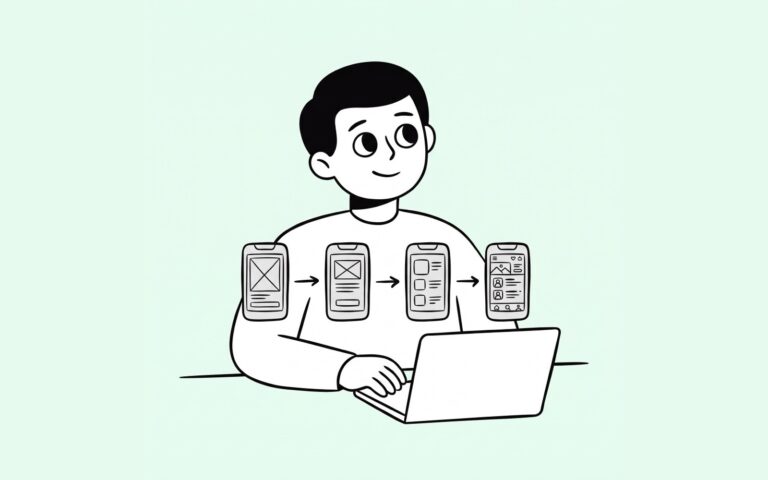
Our method, “Create, Prototype, Deploy”, merges strategy and execution:
Create: we do not accept a fixed specification. We use collective intelligence (workshops with your teams) to (co)build that strategic plan.
Prototype: we do not launch six-month developments. We use no-code and AI to deliver a testable minimum viable product within a few weeks.
Deploy: we connect those tools to your processes, bringing in automation and the human (human in the loop) to guarantee operational efficiency.
We sell neither “a site” nor “a campaign”. We (co)build working solutions (business tools, web apps, automations) that answer your strategic challenges.
Conclusion
The word “agency” covers realities too different to be useful. Rather than looking for the “best agency”, identify the right kind of partner for your precise need: brand image, traffic acquisition, technical development or process transformation.
If you feel your need sits at the crossroads of strategy and technology, and you no longer want to choose between a strategist who produces nothing and a technician with no business vision, then we are probably the right partner.
Let us talk. We can help you map your need in thirty minutes and define a concrete action plan.